09 January 2008

Double 700C and Tonic

Just before Christmas, I found myself joining the staff of a bike shop for a Christmas night out. We started in a pub before moving on to a Chinese restaurant.

Early in the evening, the boss returned from the bar with a substantial round of drinks, and we started discussing the considerable mark-up placed on drinks by the licensed trade.
Tubes and Drinks
Later in the night, we somehow got onto the subject of how we could hardly judge - seeing bike shops have their own equivalent profit-maker: inner tubes.

Drinks.
Inner Tubes.

Hmmm.

What followed was a boozy conversation which, though it seemed like a good idea at the time, is admittedly one of the geekiest in which I have ever played an active part. For some reason that I can't explain, it seemed a natural process to find an appropriate drink to match each of the inner tubes for sale in a bike shop.

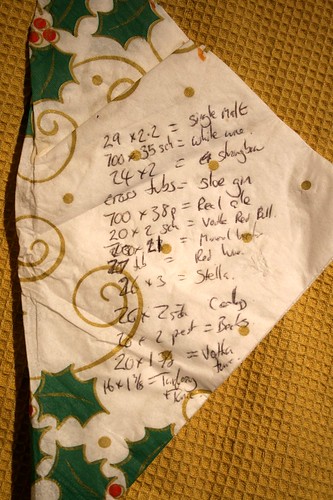
I present below our reasoned findings, transcribed from the paper napkin upon which they were noted. Make of them what you will.

Inner Tube Drink
700 x 38C Schraeder White Wine
700 x 35C Presta Real Ale
20 x 2 Schraeder Vodka Red Bull
700 x 21C Presta Mineral Water
27 x 1 3/8 Tubular Red Wine
26 x 2 Schraeder Carling
26 x 2 Presta Becks
20 x 1 3/8 Schraeder
Vodka and Tonic
16 x 1 3/8 Schraeder
Tanqueray Gin and Tonic
29 x 2.2 Presta Single Malt Whisky
700C Cyclocross Tubular Sloe Gin
24 x 2.5 Schraeder Strongbow Cider
26 x 3 Schraeder Stella Artois Lager

07 January 2008

Cycling Meets Agriculture Down on the Allotment

A couple of days after Christmas Mel and I found ourselves in the beautiful city of Bath. We spent a lazy day wandering round shopping, drinking coffee and taking in the atmosphere. I was keen to see the beautiful Royal Crescent, so on our way back to the car park we detoured through Victoria Park before we chanced upon a sizable area of allotments, where Bath's keen smallholders were cultivating their fruit and veg.

Melody loves her allotment, and the idea of snooping around other people's always excites her, so we climbed over the gate and began nosing around the cabbages and leeks. We were about to leave the allotments and resume our search for the car, when I spotted what looked like a bike, but with its front end attached to some kind of archaic mechanism.

IMG_9660


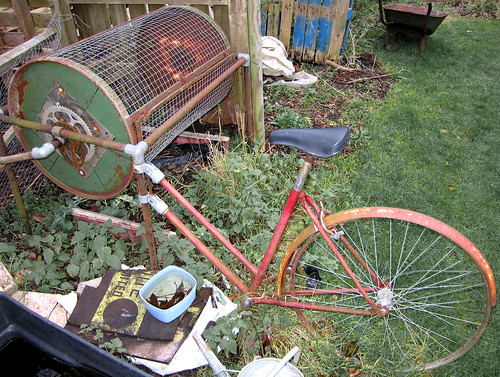
This bike had been adapted into a pedal-powered sieve, presumably to rid the local soil of stones and lumps. A chain lead forward from the pedals and was connected to a large mesh drum, which was then intended to rotate, shaking the soil contents so that fine earth falls through and rocks are retained. It was sadly not functional, else I would certainly have hopped aboard and taken it for a cheeky spin.

I've always known that bikes have the ability to solve many of the world's problems. But I never knew that lumpy soil was one of them.

IMG_9659

02 January 2008

First Ride-By Shouting of 2008

So there we were.

About half-past midnight no New Year's Eve and Mel and I are riding merrily along Brighton's seafront cyclepath.

Given the time and date, it is no surprise to see dozens of pedestrians wobbling about in the cycle lane. Understandable given the whiff of booze in the air.

So we ride along, happily honk-honking (Mel) and ting-a-linging (me) to clear a path through the merry-makers. We're greeted with countless cheery waves and new year wishes as folks get out of our way.

Until one bloke turns around and shouts "What are you doing? This isn't fucking Amsterdam!" We smile and wave back. There may even have been a bonus honk from Mel.

But he was serious: "This isn't fucking Amsterdam!". What could we say? It wasn't.

But it did smell a little like it.

19 December 2007

Anthony McCall, Serpentine Gallery

We were strolling through Hyde Park, hoping it wouldn't start to rain before we we reached Exhibition Road.

As we neared the centre of the park, the light drizzle started to increase in intensity and we looked for somewhere to take shelter. The Serpentine Gallery looked closed, but we we headed for its doors anyway, in the hope that we could find hide from the rain in its doorway.

Despite its appearance, the gallery was in fact open, so we stepped inside to see what was on display.

Anthony McCall, Serpentine Gallery

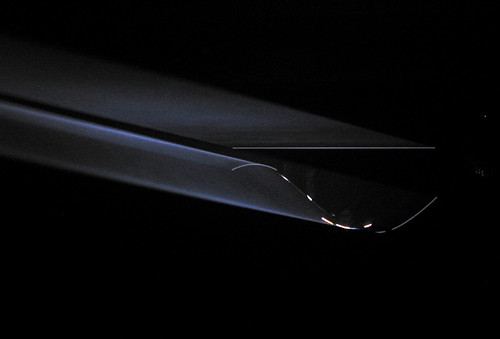
I had never before seen the work of Anthony McCall. The main focus of this show is a selection of works with titles like Long Film for Four Projectors 1974 and Line Describing a Cone 1973. These pieces are essentially darkened smoke-filled rooms, with projectors throwing ever-changing sheets of light through each gallery. The resulting three-dimensional works of art fill the room, inviting you to play with them and interact with them.

It's hard to describe how much fun this is. You walk through the rooms, disrupting the beams of light and changing the way the 'objects' appear to other viewers. One of the shapes evolves into a perfectly enclosed cone, so before it disappears, you excitedly insert your head into the cone's interior, to see it from the inside. Suddenly a chink appears in the tube of light as the head of a passing child intercepts the bottom of the beam.

Gradually, the shape changes and becomes two parallel sheets of light. You use limbs and digits to poke holes in the sheets, and watch your body cutting enormous shadows into any part of the object further from the light source than yourself.

Anthony McCall's work is showing at The Serpentine Gallery until 3rd of February. If you're passing anywhere near Hyde Park, I'd certainly recommend calling for a play.

So much fun.

17 December 2007

Is Television the New Meat?

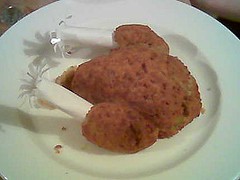
Simon's Sosmix chicken
I've not eaten meat deliberately for around 14 years. (There was that chain of accidental events back in Finikounda, but that's another story...).When I first went veggie, I became used to the curiosity of those around me: "But why not?" "Is is because of the animals?" and the classic "I bet you miss bacon."

I've grown used to all the questions over the years, but people don't seem to interrogate veggies like they used to. Their curiosity is no longer there. Being a vegetarian has become normal in our society. I am officially mainstream.

However, confess to people I don't have a television, and that's a different matter. They are fascinated. Or horrified. "What? Not at all? But how do you know what's going on? What do you do in the evening?" They are taken aback. Declining to watch television is seen as a puritanical self-denial of the most extreme kind.

Television is the new meat.

And what will be the new television? Driving licenses, I reckon.

13 December 2007

Shell Wildlife Photographer of the Year 2007

I love photography in many forms, but I've never really thought of myself as a fan of wildlife photos. Give me portraits, landscapes, sports, architecture. I've never had much time for the animals, I'm afraid.

But when Mel suggested a visit to the Natural History Museum's Shell Wildlife Photographer of the Year show, I agreed it could be worth a visit.

Wow. As someone who doesn't consider himself a fan of wildlife photos, I lost count of the amount of amazing images which blew me away. Staggering colours, amazing situations and some inspiring creatures.

It's so hard to decide on a favourite, but this shot of a bear by Sergey Gorshkov is one I will remember for a while.

The show was beautifully presented in the Jarwood Gallery of the Natural History Museum. Lightboxes were displayed around the perimeter, with winning shots shown large in enclosures in the centre of the gallery.

Also in the centre of the room were interactive displays reminiscent of Flickr's map functionality. We were able to browse the photos geographically, and were invited to email the photos to ourselves. Disappointingly, my choices have not yet appeared in my Gmail, but I don't mind when the Awards' website allows you to browse the finalists and leave comments.

It was plain to how the entrants were dominated by digital equipment, in particular the Canon 1D and other Canon cameras. Of the few photos shot on film, Fuji Velvia was the film of choice.

The show is on until 27 April. Go see.

10 December 2007

Brick Lane and East is East

Of the films I've watched recently have been a couple which address similar themes - those to do with the life of British Asians.

I bought Monica Ali's novel Brick Lane around a year ago, in the process of being snagged by a crafty bookseller's 3 for 2 promotion. The book has since sat on my bookshelf, as yet unread in a queue of similarly ignored, but no doubt worthwhile, literature. When Brick Lane recently opened in the cinema, I swallowed my guilt about the unread book and took my seat to watch this wonderful film. What a joy.

Carefully put together, the story seemed to bring together several themes - love, family, race, religion and London being the most evident. A young woman from Bangladesh marries a man unknown to her and moves to London, where she becomes part of east London's significant Bangladeshi community. Many of Brick Lane's observations are complex and worrying, but there are nuggets of joy and comedy which add a lot of depth to this lovely story.

I will certainly be dusting off that book.

Then, sorting through some DVDs the other day, I found myself in possession of another, very different, film addressing the lives of British Asians.

East is East is a cheeky comedy. Set exactly thirty years prior to the bulk of Brick Lane's narrative, it tells the story of a Pakistani man and his English wife who married in 1946 and brought up seven children. The Khan family, of Salford, have been testing out the reality of multiculturalism long before it became the norm for our cities. Throughout the film, we see the young Khans walking the tightrope between the expectations of their father and the realities of the English society in which they are growing up. In most cases, we see their challenges through the medium of comedy, but East is East is not afraid to show some upsetting, sometimes even violent scenes, especially when dealing with the father's attempts to maintain a traditional authority over his wife and children.

It was plain to see how, though different in many ways, these films were very similar in others. They may not share the same approach - Brick Lane was a touching drama while East is East borders on the slapstick, especially in its last few scenes - but they both have something to say about our country and the compromises faced by many of our citizens. Both films show that life is never simple.

Brick Lane and East is East. Very different. A little similar. Both good.